Metropol Ballroom
A Gentleman in MoscowThe Metropol Ballroom serves as a gathering place for the hotel’s increasingly frequent political assemblies and, above all, as a cramped balcony perch from which Count Alexander Ilyich Rostov and Nina Kulikova observe them unseen. The room brings revolutionary procedure into the hotel’s everyday life: crowds fill its chairs and aisles, officials preside from a dais, and arguments over a single word can become a performance of collective purpose. For the Count, who expects political discourse to be tedious, the ballroom becomes the setting for a small but genuine revision of judgment.
Setting and Hidden View
The ballroom is on the hotel’s second floor, and its balcony offers a view down into the room while keeping its occupants out of sight. That concealment comes at a physical cost. The balcony is narrow and dusty, and anyone trying to remain hidden must crouch behind the balustrade. The Count is more than six feet tall, so the position is particularly uncomfortable: during an earlier visit he tore the seam of his trousers and spent three days recovering from a crick in his neck. On this excursion, the seam gives way again as he bends down behind Nina.
Nina gets him there despite his reluctance. After skirting the entrance to the Boyarsky Restaurant and making sure the way is clear, they use her key to open an unmarked door onto the balcony. The route makes the ballroom more than a public meeting room: from the concealed threshold, Nina can turn its proceedings into a private spectacle. The Count follows her into the awkward hiding place even though he expects the gathering below to be another tedious assembly.
A Venue for Political Assemblies
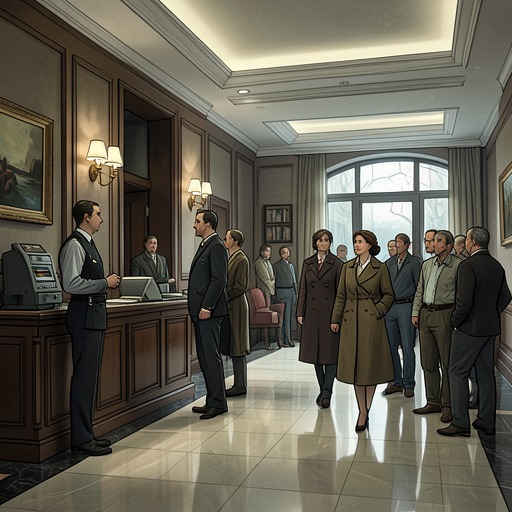
Over the summer, assemblies at the hotel become more frequent. Small groups of men hurry through the lobby, already gesturing, interrupting one another, and eager to make their points; in the ballroom, they join larger crowds standing shoulder to shoulder, many smoking. The meetings take varied forms, including committees, caucuses, colloquiums, congresses, and conventions, and address matters from codes and courses of action to complaints about familiar problems expressed in new political language.
The ballroom’s activity is not confined to a single event. On August 2, the Count and Nina watch a gathering that is already the day’s third assembly. The room is at 91 degrees. A hundred men are seated, another hundred confer in the aisles, and three prominent figures take places behind a long wooden table on the dais. The crowd, heat, and tightly arranged furniture give the proceedings a physical density that the concealed spectators experience at close range, even as the balcony keeps them apart from the participants.
The assemblies also adapt older conventions of public display. The Count notices that the room now contains more canvas than cashmere and more gray than gold, but wonders whether a patch on an elbow differs greatly from an epaulette on a shoulder. A bureaucrat in ragged clothes presides with a gavel, and the Count reads the clothing as a way of displaying working-class affiliation. In the ballroom, political change is visible not only in the meeting’s subject but in the signals of rank and belonging worn by those who attend.
Debate and Collective Decision
The assembly the Count and Nina observe is the Second Meeting of the First Congress of the Moscow Branch of the All-Russian Union of Railway Workers. A secretary strikes the gavel to call it to order; the doors close, the seats are taken, and the meeting begins. Six administrative matters are raised and settled in the first fifteen minutes, creating the possibility that the assembly might finish quickly. The next item, however, provokes a more sustained debate: a proposal to amend the Union’s charter, specifically the seventh sentence of its second paragraph.
That sentence gathers an expansive catalogue of the Union’s virtues. It celebrates the workers’ steadfastness and resolve, the sound of hammers in summer, the shoveling of coal in winter, and the hopeful whistles heard at night. Its final wording says that the railway workers facilitate communication and trade across the provinces. The proposed replacement is to enable and ensure them. The Count privately thinks up alternative pairs of verbs, treating the wording as an invitation to verbal play; the assembly treats the sentence as consequential enough for debate and a vote.
The resolution passes unanimously, with hands raised and feet stomping. From the balcony, the Count acknowledges that political discourse may not always be dull after all. The scene’s shift is modest but distinct: a meeting he anticipated as an uncomfortable ordeal holds his attention through both its careful discussion of language and its collective decision.
Narrative Significance
The ballroom joins observation and participation without making them identical. Nina’s hidden balcony excursion lets her witness the assembly from above, while the Count remains an outsider to the proceedings, physically crouched behind a balustrade and accustomed to regarding political talk as tedious. Yet the meeting’s argument over a sentence, followed by its unanimous vote, unsettles his dismissal. The room offers a close view of public speech as both procedure and spectacle: a gavel calls people to order, language is revised, and a decision is embodied in raised hands and stamping feet.
The setting also frames the contrast between revolutionary self-presentation and the older social habits the Count recognizes. Workaday clothes and collective ritual replace the visible signs of an earlier hierarchy, but his attention to dress and convention suggests how readily status can find new forms. The Metropol Ballroom thus functions as more than a backdrop for a political gathering. It is the place where changing institutions occupy familiar hotel space, and where a reluctant spectator discovers, through one particular debate, that the assemblies he has been watching may contain more than noise and repetition.